Art and Craftsmanship of Clay
The Laboratorio Borriero La Creta is a project dedicated to the revival of ceramic art and the enhancement of the tangible and intangible heritage of the Valle d’Itria. It was created with the support of the PNRR – Ministry of Culture and in collaboration with the Academy of Fine Arts of Bari, as a virtuous example of integration between artistic training, research, and cultural enterprise. Located in the countryside of Noci (BA), La Creta is a place where earth and fire once again become a creative language, a meeting opportunity, and a tool for knowledge. The laboratory promotes the transmission of artisanal knowledge and its evolution in a contemporary way, fostering the birth of new sustainable production models consistent with the identity of the territory. Among art, nature, and community, La Creta is an open and shared space: a workshop of ideas and hands, where beauty is built day by day, with the patience and precision of an ancient gesture.
How It Was Born
The Laboratorio Borriero La Creta was established within the framework of the National Recovery and Resilience Plan (PNRR), supported by the Ministry of Culture and in collaboration with the Academy of Fine Arts of Bari.
The project aims to recover and enhance the ancient arts of earth and fire, promoting the rebirth of a craft rooted in Mediterranean tradition yet open to contemporary research.
This initiative fits into the broader path of rural regeneration, offering a place where training, experimentation, and artistic production meet to generate new forms of expression and cultural enterprise.
The Workshop
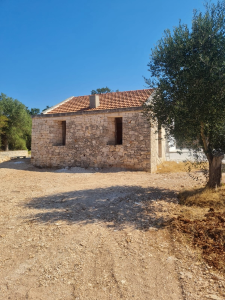
The Laboratorio Borriero La Creta is a space for design, experimentation, and production dedicated to ceramic arts.
Inside, you will find a professional kiln for high-temperature firing, an area for wheel throwing and hand modeling, and workspaces designed to host moments of collective creation and individual research.
Immersed in the rural landscape, the facilities are designed to encourage focus, sharing, and dialogue among artists, students, and artisans.
Every detail—from natural light to the layout of the spaces—has been conceived to create a living and welcoming place, where creative gestures can find their most authentic form.
Where It Is Located
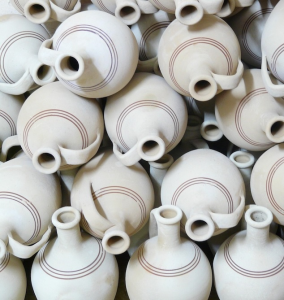
The Laboratorio Borriero La Creta is located in the countryside of Noci, in the heart of the Valle d’Itria, among trulli, olive trees, and dry-stone walls. It is a place suspended between memory and contemporaneity, where white stone and red earth still tell the story of a landscape shaped by human work.
Here, far from urban centers but in the heart of the most authentic Puglia, craftsmanship regains its original meaning: a dialogue with nature, with materials, and with time. The laboratory was born as a widespread cultural hub, open to students, artists, and travelers seeking a meeting point between creation, silence, and community.
Clay and Passion
The Laboratorio Borriero La Creta was born from a deep passion for the ancient art of earth and fire, a universal language connecting all Mediterranean civilizations.
In an era dominated by speed and mass production, ceramics represent an act of resistance and awareness, a return to the slow rhythm of the hands and the material taking shape.
La Creta is a place that experiments with the continuity between tradition and innovation, between the memory of craftsmanship and the freedom of artistic research.
Each object created here carries the trace of fire, time, and human touch: three elements that together define the very essence of craftsmanship.
The Collaboration with the Academy of Fine Arts of Bari
The Laboratorio Borriero La Creta was established in close collaboration with the Academy of Fine Arts of Bari, the project’s scientific and institutional partner.
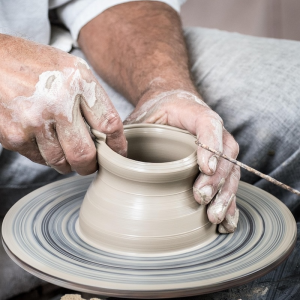
The Academy contributes artistic, educational, and research expertise, offering students the opportunity to experience hands-on workshops and residencies.
This synergy between academic education and artisanal practice represents the heart of the project: a bridge between school and territory, between theory and craft, between knowledge and know-how.
Through workshops, exhibitions, and joint projects, the laboratory thus becomes a center for experimentation and cultural dialogue, open to the local community and the national art scene.